Is AI our designated bogeyman?
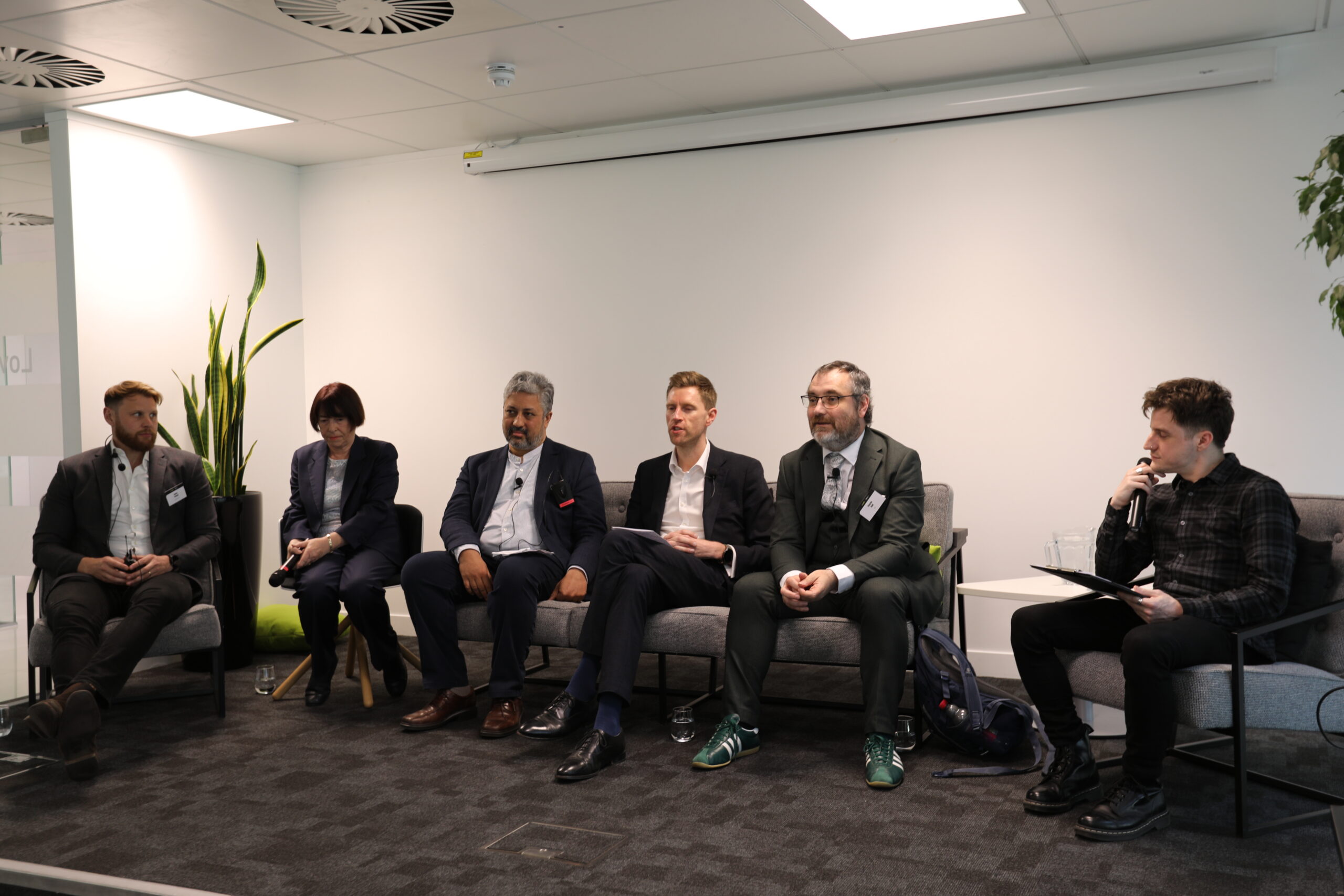
This theme kept resurfacing throughout our recent panel event, Entry-level and grad jobs in the era of AI, hosted by techUK and FDM Group. And for good reason.
There is an intense ongoing debate around AI’s impact on jobs, particularly in the context of entry-level roles. It’s true, AI is undertaking many junior level roles like data entry and document reviews which is fuelling concerns and speculation around junior talent pipelines.
However, the data on this is giving mixed signals.
Mixed signals
Jake Wall, Policy Manager for Skills and the Future of Work at techUK, set the scene for the discussion with some interesting stats.
On the one hand, job board data is showing a contraction in junior roles. Adzuna reported that UK graduate vacancies fell under 10,000 in January 2026, down 45% year-on-year. But employer-side data shows a more nuanced picture.
The Institute of Student Employers reported a smaller 8% dip in graduate hiring and a growth in apprenticeships and the number of job applications.
ONS data shows that in 2025, the graduate labour market expanded by 400,000. Meanwhile, research by Vacancysoft also found that whilst some graduate programmes have been curtailed, organisations are continuing to hire graduates on an individual basis with hiring trends expected to exceed 2025 volumes this year.
So where does that leave us?
The bottom line:
Yes, junior roles are under pressure, but the extent of AI’s impact on this versus wider macroeconomic conditions like rising costs, and changing hiring strategies may be overplayed.
This is what formed the context for the panel discussion. Led by Jake Wall, Policy Manager for Skills and the Future of Work at techUK, speakers included James Tuttiett, Global Transformation Director, FDM, Charlie Ball, Head of Higher Education Intelligence at JISC; Jenny Taylor MBE, Leader of Early Professional programmes, IBM UK, John Cope, Board Member, Youth Employment UK, and Tushar Prabhu, CEO and founder of GradVisor.
The panel set out to unpack some of this contrarian data and separate the signal from the noise.
Separating signal from noise
One of the most compelling themes from the discussion was the growing challenge of navigating what Charlie Ball described as an “explosion of polluted information.”
Put simply: there’s more data than ever before, and not all of it is helpful.
For graduates, this creates a grim view of the job market. Example: 300 applications with no response.
For businesses, it complicates decision-making.
John Cope highlighted the emotional toll of prolonged job searching, particularly for young people entering the workforce. The emotional scar of finding yourself without job stays for a long time. This loss of talent and loss of potential is also a scare for the economy and the country.
For the first time ever since records started, UK is the worst place in Europe for youth employment. A mix of factors like government decisions, high costs of hiring, and changes in skills demand – all have an impact.
The question remains: how much of this can we solely attribute to AI?
Is AI our designated bogeyman?
It’s tempting to position AI as the central villain in this story. But several panellists challenged that narrative.
James Tuttiett pointed out that AI is increasingly being used as an excuse. While it undeniably boosts productivity, it doesn’t necessarily eliminate the need for early talent. A graduate or apprentice or someone returning to work after a career break and who has taken the time to upskill themselves in new tech, is more valuable than a more experienced person with five to ten years in industry who hasn’t invested in upskilling themselves.
The systemic risk aversion
However, in today’s volatile economic climate, hiring people from non-traditional and non-linear backgrounds is a risk that organisations don’t want to take. So, when budgets are tight, they default to “safer”, more traditional hires – the Oxbridge candidates or more experienced professionals.
James also raised a broader societal question here. Should organisations have a responsibility to create local opportunities, not just optimise efficiency? And what role should government play in incentivising that behaviour?
Throwback to the 90s
One of the most powerful insights from the discussion came from a historical parallel.
The last time the labour market looked like this was in the early 1990s when the internet burst into the scene as this massively transformative and disruptive technology. Businesses at the time responded by cutting their graduate programmes en masse.
The short-term logic made sense. The long-term consequences did not.
By the late 1990s, when the economy recovered, those same organisations found themselves facing a critical shortage of experienced talent. They had no pipeline of mid-level professionals ready to step into leadership roles. Entire sectors were left batting a skills shortage that shouldn’t have existed.
There’s growing concern that we may be repeating the same mistake, only this time, with AI as the backdrop.
If organisations collectively scale back early careers hiring, the impact won’t be immediate. It will surface in five or ten years’ time, when businesses start asking: where are our future managers? Where are our experienced hires?
Changing expectations of entry-level talent
Jenny Taylor, speaking from her experience managing graduates, apprentices, and interns believes technical skills, whilst great to have are no longer the main differentiator for hiring early talent.
Human skills like curiosity, communication, problem-solving and critical thinking matter more than programming skills that can be taught on the job.
Take prompt engineering as an example. Getting meaningful output from AI tools isn’t just about knowing the technology. It’s about asking the right questions, interpreting responses, and applying judgement.
AI and social mobility
Tushar Prabhu brought the conversation back to a historical challenge that the UK has faced: social mobility. Access to opportunity in the UK has never been evenly distributed. And there’s a real risk that AI could widen that gap further.
The majority of AI or digital natives tend to be from privileged backgrounds, with the resources, and connections to support them.
And the problem with AI is that the pace of change means it’s harder to keep up with than previous technology. So there’s a huge implication to that social mobility and creating that kind of digital or “AI poverty gap” – divide between those who can keep up with the pace of change and those who can’t.
And we’re already seeing shifts in behaviour.
Only a third of people are excited by AI. Around 40% of individuals are changing their career choices because of AI. But not all of those decisions are well-informed. In a landscape saturated with conflicting information, people may be ruling out viable careers based on incomplete or inaccurate narratives.
That’s a problem.
The application paradox
AI’s impact isn’t limited to the roles themselves; it’s also changing how people apply for jobs.
People are using AI to write their applications and organisations are using AI to assess them. The application process can actually end up having no real human as part of the process.
The rise of one-click applications has made it easier to send out mass applications at once. But this surge in application numbers hasn’t been matched by the quality of applications. Even tailored applications can feel like they disappear into a void.
As James Tuttiett noted, the process is becoming increasingly “soulless.”
The impact of AI on the recruitment process has been extraordinary. Charlie Ball described this situation as a kind of “tragedy of the commons. Everyone is playing the game. But the game itself is becoming harder to win.
Investment in skills and early careers
If there’s a single thread running through all of these discussions, it’s the need for renewed investment in skills.
Employer investment in training has been declining since the 2007–08 financial crisis. Initiatives like the apprenticeship levy have helped. The UK Government’s Kickstart programme was another great incentive where £3000 was given to small businesses to take on apprentices. This had a fantastic impact for youth employment.
What’s the equivalent for today’s challenges?
We’ve seen how effective R&D tax credits have been in encouraging innovation. Could a similar model be applied to skills and training? There’s a strong case for it. Because without sustained investment, the gap between demand and capability will continue to widen.
Cutting through the advice noise
Young people, particular those looking to start their careers are often inundated with career advice. This advice, even if it’s well-intentioned isn’t always helpful or accurate. With so much being said and written about the job market and AI’s impact on roles, it can be hard to cut through the noise and find the right resources or guidance. Career advice is a specialism so even asking teachers is asking too much of them because they just don’t know.
There is hope
In the same vein of information overload and click-baitey predictions about the dismal state of the labour market and the future of graduate job, it’s important to take a step back and drain out the noise.
It’s not that the majority of graduates aren’t getting jobs, it’s the minority of those that don’t that has grown. It’s not as bad as people think.
Word of advice: don’t get blindsided by AI. It’s just another tech and in five years there will be another one. Also, ultimately AI is creating jobs.
Youth-friendly employers
Organisations need a framework to understand how to become a youth-friendly employer. They can benchmark themselves against similar companies to improve their processes, training, and support.
Once employers are equipped with these guidelines, they can promote a cultural change.
Businesses default to experienced hires, not because they’re anti-youth employment. It’s because they need to make the right hire under tight budgets and deadlines.
What does “AI-ready” really mean?
How should AI be embedded into education to better prepare students for the future?
AI is increasingly becoming a baseline capability for professionals. But being AI-ready doesn’t mean being a specialist or expert. According to James, AI-readiness means focusing on three things:
- Confidence in using AI tools
- Curiosity to interrogate and refine outputs
- Understanding the limitations and risks, including security
Interestingly, there was a suggestion that traditionally “non-technical” subjects like humanities may become even more valuable. Leaders in AI research have argued that as analytical tasks are automated society will need more people trained in ethics, philosophy and reasoning. These disciplines develop judgement and contextual thinking.
Because while AI can generate answers, it can’t determine which answers matter.
That still requires human judgement.
Next steps
The narrative around AI and entry-level jobs is far from settled.
Yes, there are real challenges. AI is changing how work gets done. But it’s also creating opportunities.
If we allow fear-mongering narratives to dominate our response to AI, we’ll end up making some short-term decisions which have adverse effects in the long-term. Going by the historical example of the market disruption in the 90s, if we once again cut graduate hiring, we jeopardise future pipelines and capability.
If, instead, we focus on building resilience through investment, education, and inclusive hiring, we can navigate this transition more effectively.
At FDM, we believe the future is one of human-AI collaboration. Our Consultants are trained in AI fundamentals, data analysis, automation, and ethical AI best practices. We help organisations integrate AI into existing processes, improve productivity, streamline workflows, and seamless scale their AI transformation projects.