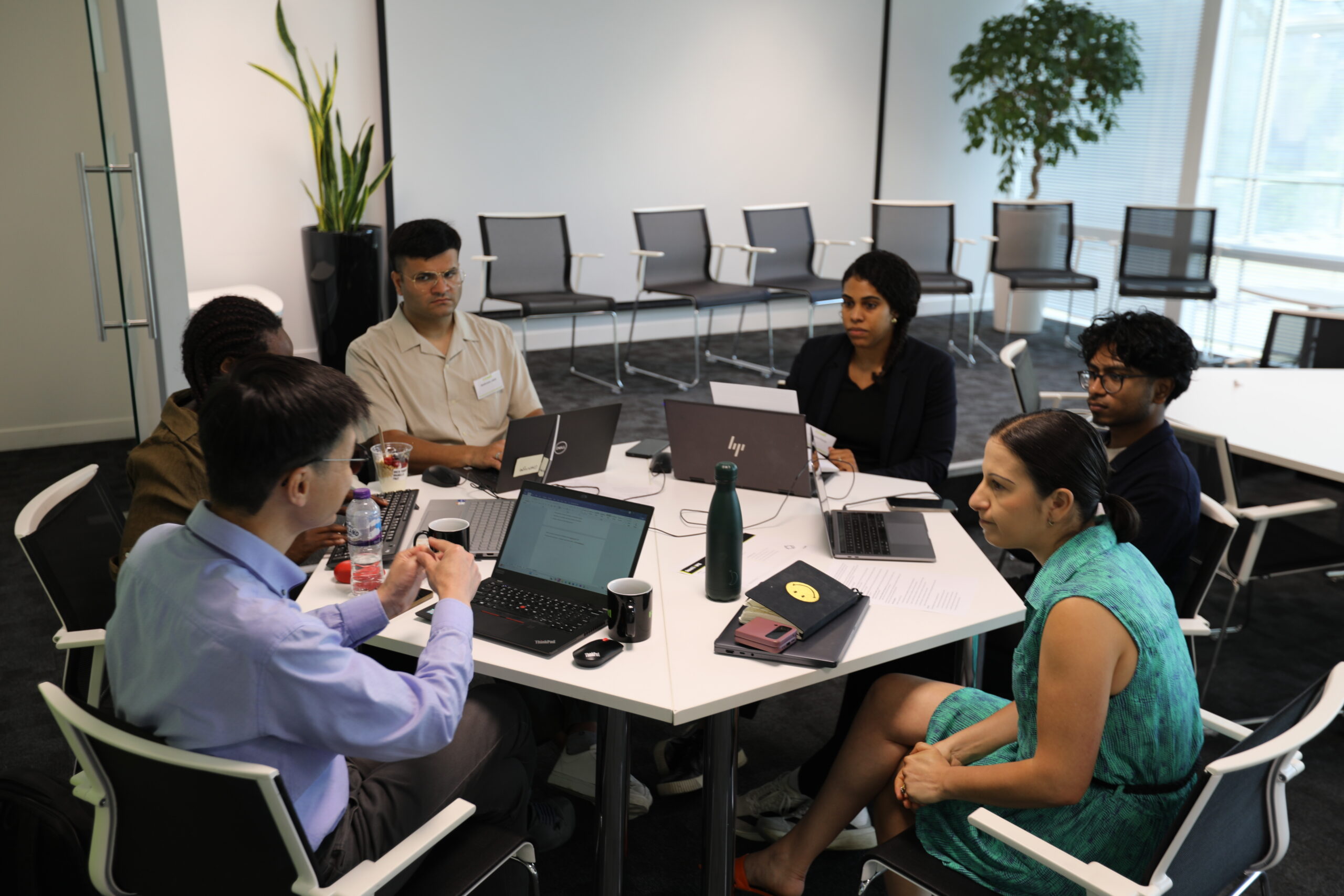
Nine squads. Nine missions.
Five hours to build a minimum viable product (MVP) using agentic engineering.
This was the premise of FDM’s Promptathon event, held last month at our London centre.
Most major organisations today talk about “working with AI” and human-AI collaboration. But what does this look like in practice?
The FDM Promptathon demonstrated what humans and AI can do together and the results agentic engineering can produce in real time. This is not just training. It’s a working proof point of facilitating and developing real, scalable solutions using agentic engineering.
The event brought consultants, clients, and internal FDM staff together, using prompt engineering to build AI agents that could facilitate a range of business cases. And that’s the point. The best human-AI collaboration is one that leverages the distinct strengths of each — the critical thinking, creativity, and domain expertise of people, combined with the speed, scalability, and precision of AI.
The Promptathon was designed to put that principle into practice.
Understanding business use cases
From an AI meeting assistant to improve the sales discovery and pipeline tracking process, to voice-enabled AI agents for capturing consultant data accurately, and AI agents to analyse CVs against role requirements, there were nine “missions” for the nine squads to achieve.
The teams had a mix of developers, business analysts, data analysts, PMOs, sales, marketing, and recruitment staff. An interesting mix of techies and non-techies.
Together, they worked on their problem statement to understand the business case, reasoned and discussed the best approach with usability and impact in mind, and used agentic engineering to generate the technical specs for the agent before using GitHub to build the tool.
James Tuttiett, Global Transformation Director at FDM Group said:
“The reason we ran a company-wide promptathon is because we want people to understand how agentic engineering is changing and how everyone can be a developer and build products themselves.
We are seeing roles change so quickly with agentic engineering that actually communication skills and understanding business requirements takes up 50% of the time now when it comes to developing products. The rest is around testing and only 20% of the run time of a project is actual coding itself and we’re using agents to do this.”
Each squad typically had: 1x Product owner, 1x Developer 1xBA, 1 Data Analyst, and non-tech participants.
We ran a similar AI Hackathon in Hong Kong last month in collaboration with a global banking client and MISSION+ focused on delivering practical outcomes.
Here too, in under five hours, teams of FDM Consultants and engineers from the client side, tackled real financial services use cases, moving from ideas to working solutions using agentic AI to accelerate progress.
The outcome showed what’s possible when collaboration is designed with purpose. Structure, delivery‑ready talent, and specialist AI capability combined to generate tangible results in a short amount of time.
This model is designed to be replicated. Whether it’s a global bank or a technology firm, the format works: bring together cross-functional talent, define real business problems, and use agentic engineering to build solutions at pace. FDM can deliver this with any client ready to move from AI ambition to AI action.
Spotlight: the sales meeting agent
One of the squads was tasked with building a sales meeting assistant.
The purpose
Build an AI-powered Meeting Intelligence Assistant that standardises how sales meetings are captured, analysed, and reviewed by automatically structuring discovery data using MEDDPICC and SPIN methodologies.
The assistant will eliminate inconsistencies in meeting logging, improve discovery quality, increase adherence to sales frameworks, and provide reliable, insight-driven pipeline visibility for account managers and sales leaders.
Desired outcomes
- Improved consistency and quality of discovery data
- Increased adherence to MEDDPICC and SPIN frameworks
- Reduced risk of missed opportunities and stalled deals
- More reliable, insight-driven pipeline management
- Reduced manual effort for account managers
- Improved managerial visibility into deal quality and risks
The team worked together to break down their specific challenge into:
- Spec building – where they generated the tech specs on Copilot by feeding in initial ideas for the use cases, acceptance criteria and user stories
- Data sources – where they included the external and internal sources for the agent to pool their data from including Salesforce, social media channels and external websites
- Build in GitHub Copilot and final refinement
The result was a prototype that generated relevant historical data for a contact when prompted, based on the inputs provided in the specs and data sources. It was interesting to see how a diverse team worked together to refine their product concept and identify gaps in its functionality.
At the end of the promptathon, all nine squads presented their products to the whole group and were judged by a panel including C-suite FDM executives.
Two years ago, a developer’s time was precious. Writing code and typing instructions is what took the time. But agentic coding has completely flipped this on its head. Today, agents can generate code very quickly.
We’re using the promptathon as a working example to show how quickly we can build production ready and environment-ready products that can be rolled out across the business. The promptathon democratises tech. We have people from internal FDM, our technical consultants, Change & Transformation Consultants – all working together to solve real world problems that members of the FDM community have raised.
Speaking about the impact of agentic AI on future job roles, James said –
“I see roles in tech changing all the time. The rapid advancement of technology like Claude Code and Codex since November last year has dramatically changed the way that organisations are creating software and that’s dramatically changing the way that roles sit within the AI software development lifecycle.
We’ll see developers moving towards BA or PO roles; smaller teams will be embedded alongside the business, onshore working to develop real world business cases in rapid time. The skillsets that will be incredibly important are understanding how to work with others, taking business requirements and translating them into technical documentation, and how to use agents to write the code.”
What’s FDM approach to building AI fluency?
“You have to be comfortable using AI tools and understanding what you want to get out of them. Part of that is technical understanding – how to structure your prompts and move towards agentic coding. Another part of that is the softer skills needed to engage with LLMs in the right way. Nowadays it’s very easy to get an answer, the harder thing is to ask the right question.
This is why we’ve based all of our principles at FDM around being Confident in how to use the tools; Curious in how to get the right answers and investigating the responses you’re getting and Secure in understanding what you’re uploading, how you’re uploading, and what you’re using the tools for.”
FDM Consultant Caroline Braganza, is a Business Analyst who participated in the Promptathon. As someone from a business background, her highlight of the day was working alongside software developers and engineers to see how they use AI in their world and how she can take those learnings to add value in her job.
Software Engineer Gustavo Antonelli, also participated in the Promptathon. He worked on a post meeting sales meeting assistant where account managers can get a transcript from their meeting where agent can summarise it and evaluate it for parts that went well and any areas of improvement whilst also updating the history of meetings with the client. He’s enjoyed getting hands-on experience in using spec-driven development and agentic coding.
“As a more traditional software engineer, my experience is more in hands-on coding so it’s important for me to get that (agentic engineering) experience.”
Looking ahead
The Promptathon marks a turning point in building AI enablement. We have moved beyond AI training to its practical use in real time where we put people in a room, give them a real problem, that they then solve using agentic engineering.
From London to Hong Kong, we’ve seen what happens when cross-functional teams of developers, data analysts, sales, and recruitment combine human judgement with AI capability. The results aren’t theoretical. They’re working MVPs, built to spec, ready for deployment.
The best human-AI collaboration doesn’t replace people. Alongside AI skills, people need to develop their soft skills. This means asking the right questions and engaging with the tools in the right way to get their desired output from them.
Human talent brings context, critical thinking, and the ability to ask the right questions. AI brings speed, scalability, and the ability to generate and iterate at pace. Together, they produce outcomes that beat individual outputs.
FDM’s Promptathon model is repeatable, scalable, and open to any organisation ready to move beyond AI pilots.
Ready to take your AI project from pilot to production?