
Case Studies
Paul Brown
11 February 2021
Case Study
PUBLIC SECTOR
AI-powered chatbot reduces manual reconciliation time by 60% for UK regulator
At a glance
Our client, a national UK government regulator responsible for public safety, required a large-scale digital transformation update. This would comprise technical, data, and business architecture, plus AI integration.
Every year, the client created Annual Assurance Reports. After 14 years, this had accrued into over 1000 pages. As part of the AI delivery project, FDM Consultants streamlined information capture and data retrieval from these pages using an internal AI-powered chatbot.
FDM Practices
- Change & Transformation
- Data & Analytics
- Risk, Regulation & Compliance
Industry
Public Sector
Tech stack
Streamlit
Snowflake
OpenAI
Azure
Chroma
PyPDF2
Python
LangChain
FAISS
Impact
60%
reduction in manual reconciliation time
30
seconds to answer FAQs, down from 48 hours
Five
weeks to create report, down from three months
Seven
weeks prototype delivery timeline
To reduce the cost to the client, the consultants used open-source AI tools to develop the chatbot. The first working prototype was ready within seven weeks and was quickly deployed amongst the client’s first-line agents.
Following feedback, the chatbot was enhanced to include additional data sources. The prototype has now evolved into a usable system, now actively supporting operations.
Constrained by data retrieval challenges
Every year, the client publishes their Annual Assurance Report. When FDM was consulted, the client had accrued over 1000 report pages, densely packed with hundreds of accident enquires, and thousands of PDF pages, images, and graphs.
They faced numerous challenges, including:
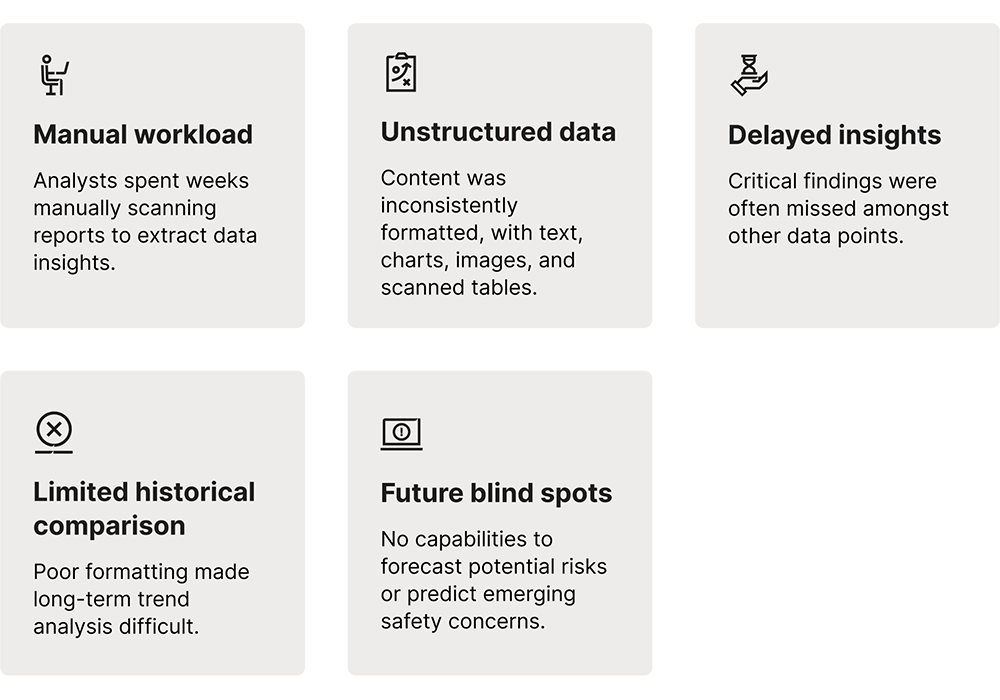
The client sought a solution that would streamline the data reconciliation process, boost efficiency, and improve decision making simultaneously.
Thousands of data points made accessible by AI
During the Discovery phase of the project, the consultants worked to understand the internal use cases, and the answers they most frequently sought.
After gaining holistic knowledge of the client’s needs, the consultants began to segment the information within the reports into smaller text extracts for semantic search delivery.
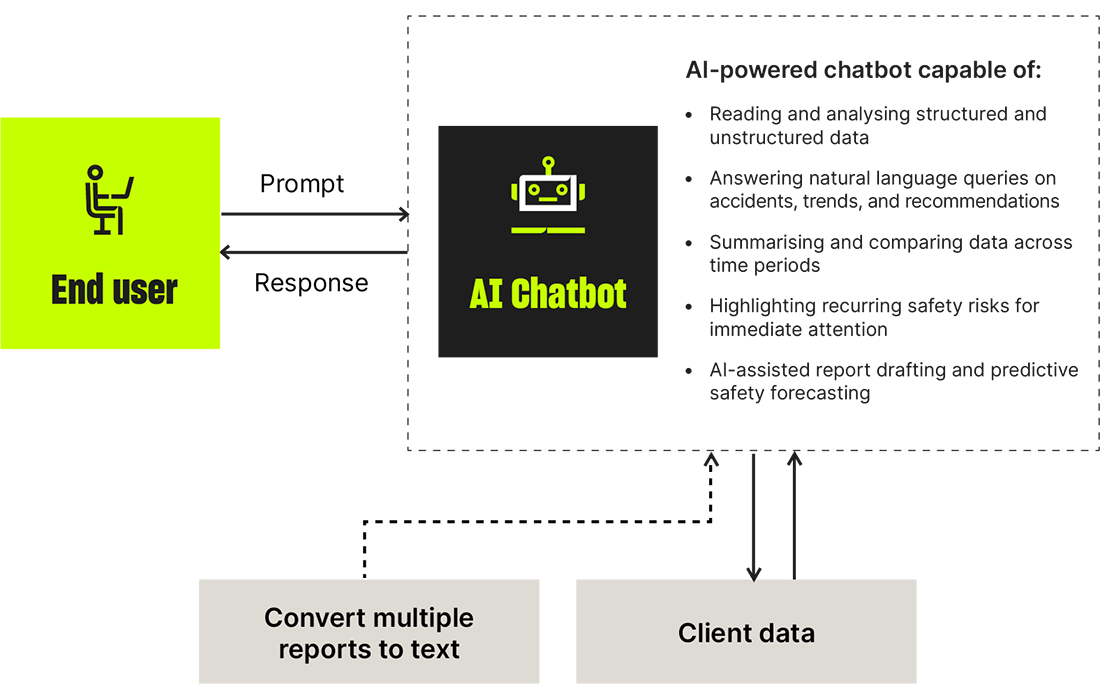
The chatbot was built to retrieve the most relevant text extracts related to the queries, whilst also using a separate data bank to react to follow-up questions. The consultants used a 16K context-length model to handle the large document sections.
This process involved the creation of a Retrieval Augmentation Generation (RAG) pipeline to interact with each unique data set, as well as the configuration of vector and semantic data searching, implementation of security messages to prevent prompt injection, and the use of an SQL database to save messaging history.
To maintain security and compliance measures were met at every stage and after rollout, the team enforced access restrictions for sensitive data.
Building for an AI-powered future
The chatbot was designed for proactive capabilities.
As well as retrieving historical data, the chatbot can now draft the annual reports with summaries, trends, and recommendations. Analyst time on the tasks has now been cut to reviewing and refining, reducing report preparation time by weeks.
Predictive analytics and risk forecasting has become easier, as models trained on multi-year data can forecast emerging risks, whilst statistical models can identify leading indicators of accidents for intervention.
Previously, data was siloed across the client’s nine domains. Using AI, teams can now detect recurring causes or themes across operations and spot hidden risks that accumulate over time.
The framework itself is modular and reusable, built for adaptable data handling, easy integration, and customisable queries. The cloud-first architecture is deployable across Azure, AWS, or GCP.
Conclusion
Using compatible technologies and open-source AI, FDM’s Consultants successfully enhanced the client’s operational efficiency. By reducing the manual data reconciliation process from hours to seconds, internal teams are now able to allocate time to high-value tasks. Simultaneously, teams are now using the faster and more accurate insights generated by the chatbot to enhance business decision making. The cost-effectiveness and condensed timeline of the chatbot deployment also makes it a scalable solution for the wider business.